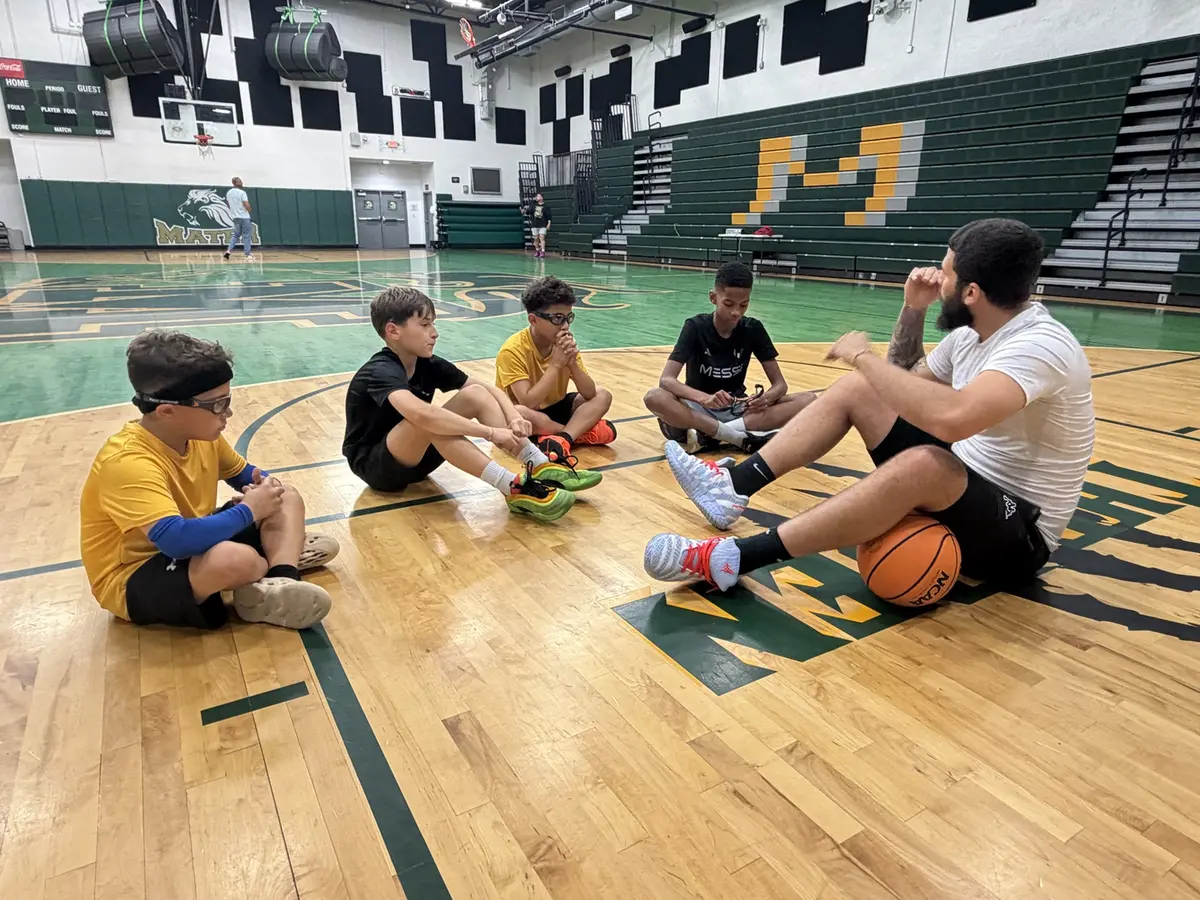
To talk about basketball in Miami is to talk about abundance and fragmentation at the same time. There are courts, leagues, coaches, academies, school teams, community programs, and competitive circuits. Yet many families still struggle to answer three basic questions: where does a serious path begin, what is a family really buying when it pays for training, and how is progress measured beyond playing more games?
01 The Miami paradox: a lot of activity does not always mean a system
Miami-Dade has an important public foundation. In 2026, the county parks system reported 309 parks, 69 recreation centers, and 123 basketball courts. That infrastructure supports initial access to the game and community programs. But a court inventory does not show how many hours are available for guided development, the quality of training, or whether recreation, school, academy, and competition are connected.
That reveals the first key distinction: playing, training, and developing are not the same thing. Playing creates experience; training improves a task; development requires assessment, priorities, purposeful repetitions, appropriate competition, and evaluation. When these elements are disconnected, the athlete accumulates activities without a clear path.
02 The structural challenge: layers operating without enough connection
The youth ecosystem usually operates across four layers with different purposes:
- Public recreation: widens the entry point, offers play, and builds community.
- School: organizes competition within institutional schedules and goals.
- Academy or private coach: develops skills and addresses specific needs.
- Club or travel circuit: adds competition, exposure, and experiences beyond the local environment.
The problem begins when one layer promises to solve everything or when a family must coordinate all four without guidance. A travel team does not replace technical correction. An individual session does not replace reading the game with teammates and defenders. A recreational league may not provide the workload an athlete with greater aspirations needs.
“The real gap is not only a lack of opportunities. It is the lack of connection between opportunities.
A mature structure should help coaches, families, and programs understand the role of each experience, the athlete’s workload, and the priority of the next cycle.
03 The economics of the process: the visible price is only one part
The cost of youth sports is not limited to an academy fee. It includes registration, uniforms, shoes, transportation, tournaments, travel, food, camps, private sessions, and above all, family time. The Aspen Institute’s latest national survey found that a sports family spent an average of $1,016 on one child’s primary sport in 2024, up 46% from 2019. The same study estimated nearly $1,500 when other sports were included.
Those figures are national and do not represent a specific Miami fee. They help explain the accumulated pressure. In Miami-Dade, where median household income was $71,753 and 14.2% of the population lived below the poverty line in the 2020–2024 data, a path funded only by private payments risks selecting for financial means before commitment or potential.
The barrier is also logistical. Another national Project Play study estimated that parents spend an average of 3 hours and 23 minutes each day a child has practice or a game. In a large, car-dependent region, schedules, distances, and traffic can limit a program’s true reach even when its price seems reasonable.
Accessibility does not simply mean lowering prices. It means designing formats, schedules, scholarships, groups, and paths that make the process sustainable.
04 The real reach of academies: depth versus scale
An academy can create deep transformation in a small group while having limited community reach. That tension is not necessarily negative: individual attention requires time, space, and prepared coaches. The mistake is confusing digital visibility, athlete count, or tournament volume with development quality.
To evaluate true reach, consider at least five dimensions:
- Access: who can enter and what financial or geographic barriers exist.
- Continuity: how long the athlete stays and whether the recommended frequency is sustainable.
- Quality: the experience, methodology, and supervision provided.
- Results: what is measured and how progress is communicated.
- Transfer: whether improvement appears in in-game decisions and performance.
The national context confirms demand: youth participation in organized sports rose to 58% in 2024. However, Project Play reported that the household-income gap continued to widen. Growth therefore cannot mean only adding clients; it must also mean building bridges so more children can reach quality experiences.
05 Toward a better academy model in Miami
A modern academy must honestly define the problem it solves. It cannot guarantee scholarships, selections, or professional careers, but it can offer a serious process. In our view, that model requires seven commitments:
- 01Evaluate before prescribing
The program begins by understanding the athlete, not automatically assigning a session.
- 02Define goals by cycle
Priorities must be concrete, observable, and reviewable.
- 03Combine contexts
Individual work, small groups, and game play serve complementary roles.
- 04Measure what matters
Technique must transfer to better decisions, confidence, and game understanding.
- 05Communicate with families
Parents need to understand the path, workload, and purpose of each investment.
- 06Protect the child
The athlete’s safety, privacy, dignity, and image are part of the method.
- 07Expand access
Partnerships, sponsorships, partial scholarships, and tiered formats should be part of growth.
The CDC recommends at least 60 minutes of moderate or vigorous physical activity daily for youth ages 6 to 17. Basketball can strongly support that goal while developing coordination, discipline, relationships, and confidence. But an academy’s value should not be measured only by keeping a child busy. It should be measured by its ability to provide direction, protect the experience, and build sustainable progress.
Conclusion: from a collection of practices to a development system
Miami does not lack passion for basketball. It does not lack talent or people willing to work. What it needs is stronger coordination: understandable paths, honest expectations, cooperation across layers, and economic models that balance quality with access.
Athlete Lab Basketball was born within that conversation. Our proposal is to treat every athlete as a unique process: evaluate, plan, train, measure, and adjust. This is not about adding another academy to the map. It is about helping build a better system around every child and family. We create the formula. We trust the process. We develop athletes.
Sources and methodological notes
National data is identified as such and should not be interpreted as Miami-specific prices or outcomes.
- Miami-Dade County Parks: inventory of parks and recreational facilities, 2026
- U.S. Census Bureau QuickFacts: Miami-Dade County, 2020–2024
- Aspen Institute Project Play: family spending on youth sports, 2024
- Aspen Institute Project Play: family time investment, 2025
- Aspen Institute Project Play: youth sports participation, 2024
- CDC: physical activity recommendations for youth ages 6 to 17

Athlete Lab Basketball
A development and whole-athlete management laboratory for every athlete. Miami, Florida.